Nurses’ wearable tracking is personal sleep, activity, and recovery monitoring with the aim of making informed habit decisions around changing shifts. This 2026 guide to wearable tracking for nurses explains how to compare similar workdays, use included core tracking without a required subscription, and choose a device without treating its readings as medical advice.
- Wearable tracking for nurses works best when sleep and recovery trends are compared across similar shifts.
- Hume Band 2.0 works independently; Hume Pod is optional for body-composition tracking.
- Hume Health includes core app tracking without a required subscription; premium coaching and deeper personalized analysis are optional upgrades.
- Follow your workplace’s wearable policy, and never use a recovery score to decide whether you are safe to work.
Why wearable tracking matters for nurses
A nurse’s tracking routine needs to accommodate work, sleep, and days off that do not always follow the same timetable. A calendar-day total alone does not explain whether you slept after a night shift, worked late, or removed your device during patient care.
The useful question is not whether every number improved. It is whether you can connect a recurring pattern with a practical decision, such as protecting your sleep window or reconsidering an extra workout after a demanding shift.
Hume Health wearable tracking is best for adults who want sleep, activity, and recovery trends with no required core-tracking subscription. The Hume Health app brings wearable and body-composition insights together, but you do not need both devices to start.
For nurses, workplace rules come first. A personal tracker does not establish fitness for duty, replace an occupational-health assessment, or override infection-prevention requirements.
How to build a useful tracking routine in 2026
Start with one question you can act on
Before buying anything, use a notebook or a personal note on your phone. Write down your shift type, sleep period, and how you feel after waking. Keep patient information and clinical details out of that record.
Choose a question that connects to a decision you control. For example: does an earlier wind-down routine make your daytime sleep easier to protect? That is more useful than collecting every available metric without knowing what you will do with it.
Make your first review after 7 days. This is a suggested check-in, not a medical threshold or a promise that a pattern will emerge within a week. If the record does not contain comparable shifts, keep collecting context rather than forcing a conclusion.
- Record whether each day involved a day shift, night shift, or time off.
- Note your main sleep period and any naps.
- Describe waking energy in your own words.
- Choose one habit question before adding more measurements.
Check whether wearing a device fits your work
Read your employer’s current policy before making workplace wear part of your plan. Follow the rules that apply to your role and care setting, including any restrictions on wrist-worn items.
If you cannot wear a tracker during clinical work, decide whether tracking outside work still answers your question. Sleep and off-duty observations can remain useful, but a record with the working hours missing is not a complete account of your activity.
Do not move a wrist device to another body location and assume its measurements remain valid. This guide does not establish alternate-wear compatibility, cleaning-agent compatibility, or suitability for a particular clinical environment.
- Identify the wearable rules that apply to your unit.
- Remove the device whenever workplace policy requires it.
- Note off-wrist periods in your personal log.
- Keep personal tracking separate from patient documentation.
Choose the device around the question
A manual record gives you context. A wearable adds recorded trends that you can review alongside it. In 2026, start with the measurement you need rather than assuming a larger setup will produce a more useful answer.
Hume Band 2.0 is best for adults who want to follow sleep, activity, strain, and recovery trends. Hume Band 2.0 works on its own, and core app tracking does not require a subscription. Premium coaching and deeper personalized analysis are optional paid upgrades.
Hume Pod is an optional at-home body-composition analyzer. It addresses a different question: how your body-composition measurements change over time. Adding Hume Pod does not make Hume Band 2.0 necessary for body-composition tracking, or make Hume Pod necessary for wearable tracking.
Neither device tells you why a symptom is happening. Keep your observations, the device’s estimates, and medical assessment distinct.
- Choose Hume Band 2.0 for wearable habit trends.
- Add Hume Pod only if body-composition tracking serves your goal.
- Begin with included core tracking rather than assuming an upgrade is required.
- Keep a short manual note for context the device cannot explain.
Compare similar shifts before interpreting a trend
Build comparisons around your schedule. Compare daytime sleep after night work with other daytime sleep after night work, rather than treating every sleep period as interchangeable.
Use the same approach for activity. A workday, an off-duty day, and a day with a separate workout represent different circumstances. A higher activity total does not, by itself, tell you which day supported your recovery better.
Try a 2-week observation period before making a habit change. This is a suggested organizational approach, not a validated assessment window. If those weeks contain different shift patterns, label them separately instead of averaging away the context.
Group your notes under these labels: Day shifts, Night shifts, and Days off. Those simple categories make it easier to see what you are actually comparing.
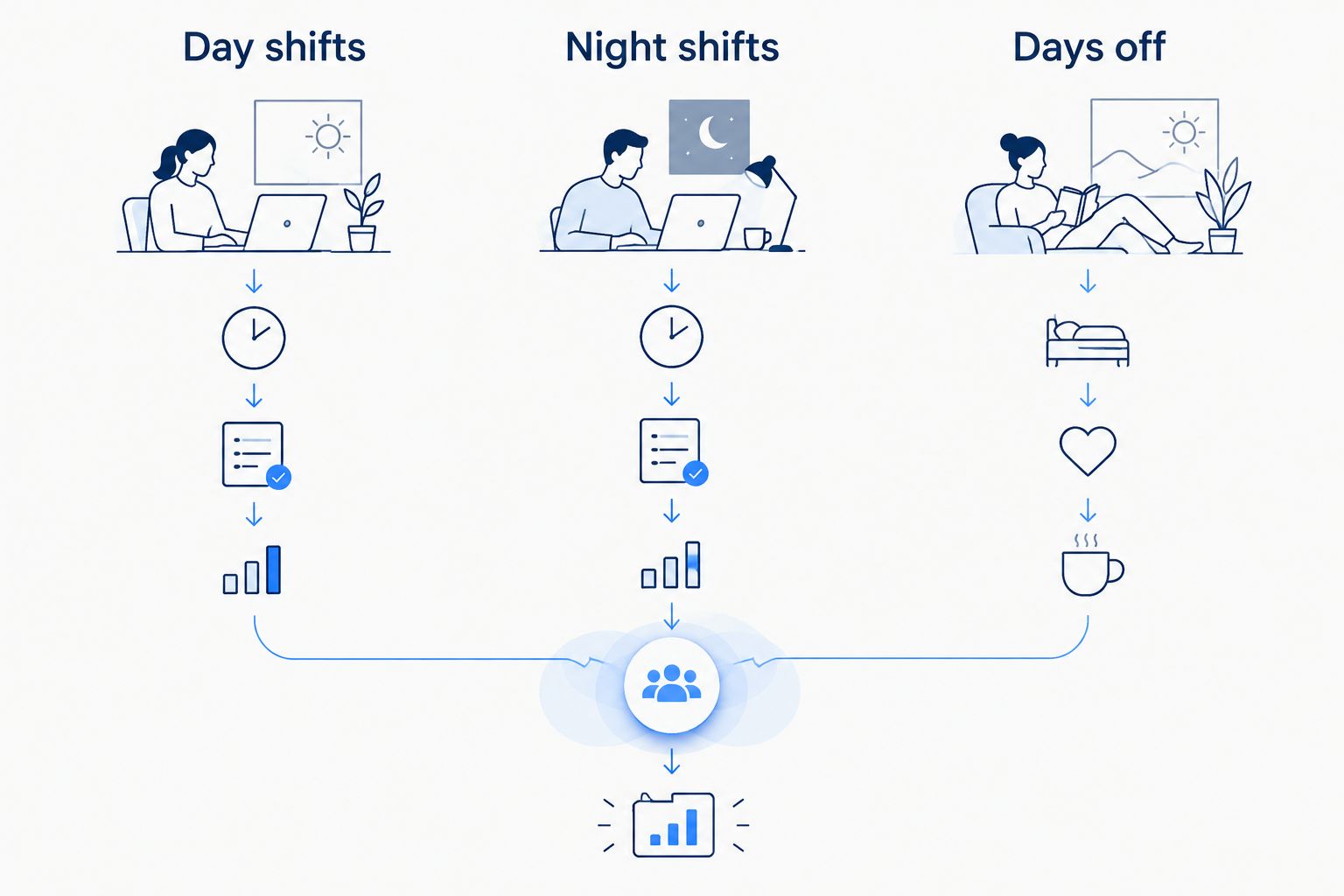
A trend becomes more informative when you know what happened around it. Missing wear time, a changed schedule, or an unusual day belongs beside the reading, not outside your interpretation.
- Compare sleep periods following the same shift type.
- Separate workdays from days with planned exercise.
- Record schedule changes alongside your observations.
- Mark incomplete records rather than treating them as full days.
Turn each measurement into a modest decision
A measurement earns its place when it informs a practical choice. Sleep trends can help you review how you protect your sleep opportunity. Activity trends can help you distinguish work movement from planned exercise. Strain and recovery trends give you another observation to consider alongside how you feel.
Do not let a favorable reading cancel out exhaustion, pain, or feeling unwell. Consumer tracking is not a diagnosis, and a score is not clearance for a demanding shift or workout.
Change 1 habit at a time when possible. For example, keep your schedule notes while testing a more consistent wind-down routine. If you change several things together, your record cannot clearly separate their effects.
- Use sleep trends to review your wind-down and sleep opportunity.
- Use activity trends to describe your routine, not assign yourself extra steps automatically.
- Consider strain and recovery alongside energy, soreness, and symptoms.
- Keep the habit change small enough to repeat during a workweek.
Review your record without turning it into another task
Set a brief weekly review instead of reacting to every reading. Look for repeated observations across comparable days, then decide whether your chosen habit remains practical.
For a 2026 tracking routine, a useful review ends with a decision: continue the habit, adjust the plan, or stop collecting a measurement that serves no purpose. You do not need a perfect dashboard to make a sensible observation.
If tracking creates pressure to earn a better score, reduce the number of measurements you review. The point is to understand your routine, not create another performance target after work.
- Review comparable shifts together once a week.
- Write one sentence about the pattern you noticed.
- Choose one action for the next review period.
- Bring persistent symptoms to a qualified healthcare professional rather than interpreting them through scores.
Compare tracking options for nurses
The right setup depends on the question you want to answer. The 2026 comparison below separates personal context, wearable trends, and optional body-composition tracking without assuming every nurse needs every device.
| Option | Best for | What it contributes | App membership |
|---|---|---|---|
| Manual sleep and shift log | Recording schedule context and personal observations | Shift labels, sleep notes, and how you felt | No app membership needed for a paper log |
| Hume Band 2.0 | Following sleep, activity, strain, and recovery trends | Wearable insights to review alongside your routine | Core tracking requires no subscription; premium coaching and deeper personalized analysis are optional |
| Hume Band 2.0 with Hume Pod 2.0 | Following wearable trends and body composition together | Wearable insights plus at-home body-composition tracking | Core tracking requires no subscription; premium upgrades are optional |
A manual log depends on what you enter. Wearable records depend on when you wear the device, and measurements still need context. Hume Pod adds body-composition tracking, not an explanation for a difficult shift or disrupted sleep.
Start with Hume Band 2.0 if wearable trends are your main goal. Add body-composition tracking only when you have a separate reason to follow it. You do not need to buy both to use Hume Health core wearable tracking.


Common wearable-tracking mistakes nurses make
Treating a work shift as a complete exercise assessment
Work movement and a planned workout are different contexts. Record both, but do not assume an activity total measures strength, fitness, or readiness for additional exercise. Consider how you feel before adding another demand to the day.
Comparing daytime sleep with unrelated nighttime sleep
A sleep period after night work deserves its own context. Keep the preceding shift and sleep timing visible, especially when your schedule rotates. Otherwise, a change in schedule can look like a change in your habits.
Treating off-wrist time as inactivity
A device removed for clinical duties cannot provide a complete wearable record of that period. Mark the gap. Do not interpret a lower recorded total as proof that the shift involved less movement.
Using a score to overrule symptoms
A recovery reading does not determine whether you are safe to drive, work, or exercise. Follow workplace procedures and seek appropriate medical advice for symptoms. Personal tracking supports observation; it does not replace clinical judgment or care.
FAQ
What is wearable tracking for nurses most useful for?
Wearable tracking for nurses is useful for observing sleep, activity, strain, and recovery trends alongside changing shifts. Compare similar shift types and connect each measurement with a practical habit decision rather than treating daily scores as targets.
Can I wear Hume Band 2.0 during a nursing shift?
Your employer’s policy determines whether you can wear Hume Band 2.0 during clinical work. Follow the requirements for your role and care setting; this guide does not establish approval for any clinical environment.
Does Hume Band 2.0 require a subscription?
Hume Band 2.0 core app tracking does not require a subscription. Premium coaching and deeper personalized analysis are optional paid upgrades.
Do I need Hume Pod to use Hume Band 2.0?
No, Hume Band 2.0 works on its own. Hume Pod is an optional at-home body-composition analyzer, and the companion Hume Health app brings wearable and body-composition insights together.
How should I compare sleep when I rotate between day and night shifts?
Compare sleep periods that follow similar shift types. Keep daytime sleep after night work separate from nighttime sleep after day work, and record schedule changes beside your observations.
Can a wearable tell me whether I am recovered enough for a shift?
No, a consumer wearable does not establish fitness for duty. Consider symptoms and how you feel, follow workplace procedures, and use appropriate medical care rather than treating a recovery score as clearance.
What should I do when I cannot wear my tracker at work?
Mark the work period as missing wearable data and keep a brief personal shift note. Off-duty tracking can still support your sleep and habit observations, but the record does not represent your full workday.
One last thing
An off-wrist gap is a gap in the record, not a failed day. For your 2026 routine, the most useful addition to a wearable can be a plain note that says you worked nights, changed shifts, or removed the device for clinical duties. That context helps you avoid drawing the wrong conclusion from an otherwise clear-looking chart.