Frequent travelers’ wearable tracking is the use of a wearable and habit notes to understand sleep, activity, and recovery across changing schedules, with the aim of making more informed daily choices. In 2026, the useful comparison is your travel routine against your own usual pattern, not an airport day against an ordinary day at home.
- Hume Band 2.0 suits frequent travelers seeking sleep and activity insights with no subscription required for core tracking.
- Wearable tracking for frequent travelers works best when sleep tracking includes local bedtime and travel context.
- Compare similar travel days, not an overnight flight with a normal night at home.
- Hume Band 2.0 works independently; Hume Pod is optional for at-home body-composition tracking.
Why wearable tracking matters for frequent travelers
Travel changes the context behind your numbers. An overnight flight interrupts your usual sleep opportunity; a conference adds sitting; a sightseeing day adds walking. A chart without those details leaves you guessing about what changed.
Hume Band 2.0 is best for frequent travelers who want sleep, activity, and recovery insights with no required subscription for core tracking. The Hume Health app brings those wearable insights together, while optional premium coaching and deeper personalized analysis are separate from included core tracking.
Your goal is not to make every travel day resemble home. It is to notice repeatable patterns and decide which habits deserve attention. For your 2026 travel routine, prioritize information that helps you answer a practical question: Did you protect enough time for sleep? Did meetings crowd out movement? Did your usual routine return after the trip?
Build a travel-tracking routine you can repeat
1. Define the question before collecting more data
Start with a notebook or a phone note. Choose a question you can answer through observation, such as whether early departures consistently shorten your sleep opportunity. You do not need a device to identify a schedule that leaves too little time in bed.
Separate the habit from the measurement. Bedtime is something you can influence; recorded sleep is an estimate of what happened. Keeping both helps you avoid treating an app reading as a complete explanation.
For a 2026 tracking plan, choose one main question per trip rather than reviewing every available chart. This is an organizational choice, not a medical threshold. A narrow question makes your notes easier to interpret when you return.
- Write the habit question before departure.
- Record your usual bedtime and wake time.
- Note whether the trip involves overnight travel.
- Decide which observation would change your routine.
2. Establish a personal baseline at home
Record an ordinary stretch of home life before comparing it with travel. Include workdays and days off, and note anything unusual. A baseline built during an exceptionally busy week is not a neutral picture of your normal routine.
You can do this manually with sleep times, a daily movement note, and a brief description of how you feel. The purpose is to establish context, not to assign yourself a health grade.
Use a 7-day home log as a manageable starting exercise. Seven days is a suggested logging period, not a promise that you will establish a medically meaningful baseline. If the week is unusual, label it rather than treating it as your standard.
- Record bedtime and wake time using local time.
- Describe activity as ordinary, lighter, or heavier than usual.
- Note late work, celebrations, or disrupted nights.
- Keep unusual days visible instead of deleting them.
3. Choose wearable insights that answer your question
Manual notes show what you intended to do. Wearable tracking adds recorded trends you can review alongside those notes. Hume Band 2.0 helps you understand sleep, activity, strain, and recovery without making an at-home scale a prerequisite.
Choose Hume Band 2.0 for wearable tracking; add a body-composition device only if that answers a separate question. Hume Band 2.0 works on its own. Included core app tracking requires no subscription, while premium coaching and deeper personalized analysis are optional paid upgrades.
For travelers, the important distinction is between a useful observation and a diagnosis. A sleep or recovery insight can prompt you to review your schedule. It does not establish why you feel unwell or replace medical assessment.
- Use sleep trends to review your sleep opportunity.
- Use activity trends to spot unusually sedentary travel days.
- Review strain and recovery alongside your actual schedule.
- Keep a short note about how you feel.
4. Label travel days before interpreting them
Keep a simple written label beside your observations. Useful categories include home, transit, destination, and return. These labels belong in your notes; they do not require a particular app feature.
Clock times need context when you cross time zones. Write the location or time zone beside bedtime and wake time so you know which clock you used. Otherwise, an apparent schedule change can be difficult to reconstruct later.
Compare like with like wherever possible. A destination workday is a more relevant comparison for another destination workday than for an overnight flight. Avoid combining every part of a trip into a single explanation.
- Label each day as home, transit, destination, or return.
- Record local time beside sleep notes.
- Mark overnight flights separately from hotel nights.
- Note whether a day involved meetings or sightseeing.
5. Review patterns and choose one adjustment
Start with your notes, then examine the corresponding wearable trends. If late meetings repeatedly leave less time for sleep, the schedule itself deserves attention. You do not need to identify a precise biological cause before recognizing a practical constraint.
Choose one modest adjustment that matches the observation. For example, reserve an earlier wind-down period when your itinerary allows it, or plan a walk during a long meeting day. Avoid changing several habits and then attributing every difference to one of them.
Hume Health wearable tracking supports this review by bringing observations into the app. Use the information to make a decision, not to chase a better-looking chart. Your next trip provides another opportunity to observe the same question, not proof of cause and effect.
- Review notes before interpreting a trend.
- Identify one repeated schedule problem.
- Choose one practical habit adjustment.
- Record what changed and what stayed the same.
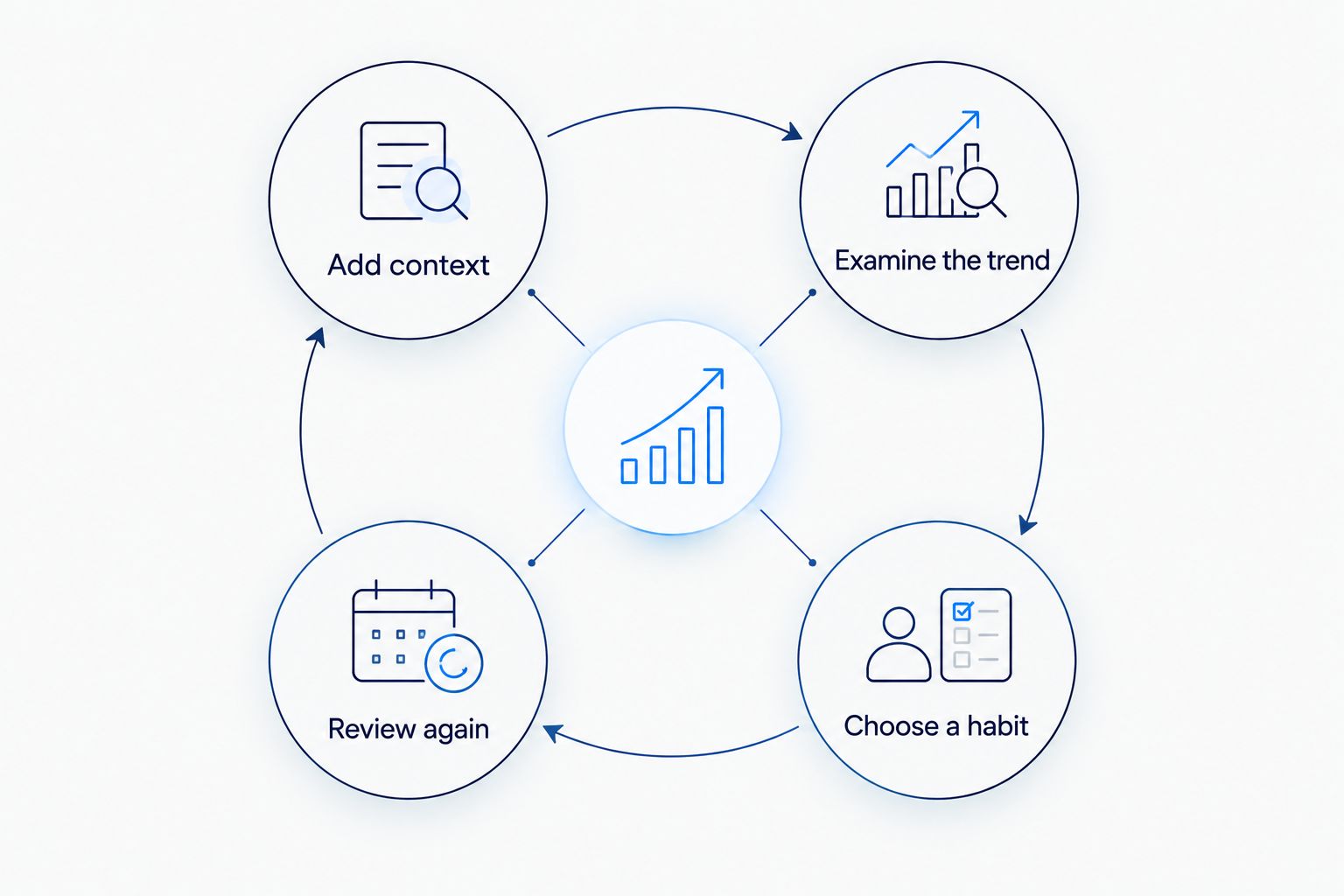
The review process is simple: add context, examine the trend, choose a habit, and review it again. Repeating that sequence keeps a travel log useful without turning your trip into a monitoring project.
6. Separate connectivity planning from health interpretation
Travel planning has two different jobs: keeping your devices usable and understanding the information they record. Keep those jobs separate. A missing record is a gap in information, not evidence that your sleep or recovery suddenly changed.
Cellular connectivity also belongs in its own category. The distinction behind using eSIM on a smartwatch is that an eSIM concerns cellular service, not whether a wearable can explain a health trend. Do not infer cellular support from the fact that a device is a wearable; this guide makes no eSIM claim for Hume Band 2.0.
Keep your routine simple enough to continue on busy travel days. A paper note preserves context even when you are not reviewing an app, and an honest gap is more useful than a reconstructed entry presented as certain.
- Pack the charging equipment for the devices you take.
- Keep a brief written backup of sleep times.
- Mark missing records instead of guessing.
- Separate connectivity questions from health conclusions.
Compare tracking options for your 2026 travel routine
Start with the question, then choose the setup. These options serve different purposes, and buying more equipment does not remove the need for context.
| Option | Best for | What it contributes |
|---|---|---|
| Manual travel log | Travelers starting with a specific habit question | Written sleep times, schedule details, and personal observations |
| Hume Band 2.0 | Travelers seeking wearable sleep, activity, strain, and recovery insights | Wearable trends with included core app tracking and no required subscription |
| Hume Band 2.0 with optional Hume Pod | Travelers who also want at-home body-composition tracking | Wearable insights and body-composition information in the companion app |
A manual log depends on what you remember to record. Wearable information still needs interpretation, and consumer tracking is not a diagnostic assessment. Hume Health core tracking does not require a subscription; optional premium coaching and deeper personalized analysis are separate.
Hume Pod is an at-home body-composition analyzer, not a requirement for travel tracking. If body changes are part of your longer-term question, treat home measurements as a separate routine rather than packing another device for every trip.
Common mistakes frequent travelers make
Treating an overnight flight like a normal night
An overnight flight does not provide the same setting or sleep opportunity as your bedroom. Label it as transit and interpret the record within that context. Do not turn a disrupted travel night into a conclusion about your usual sleep.
Comparing different clocks without keeping notes
A bedtime written without a location becomes ambiguous after a time-zone change. Record local time and location together. This small detail makes later comparisons much easier to understand.
Treating a recovery insight as permission or prohibition
A consumer wearable does not decide whether you are medically safe to exercise or travel. Consider your symptoms and circumstances, not just an app reading. Seek medical care for concerning symptoms rather than relying on tracking to explain them.
Changing everything after one difficult trip
A single trip includes too many moving parts to establish a cause. Keep the observation, identify one practical change, and review the question again on a comparable trip. Do not promise yourself that a particular habit will produce a particular score.
FAQ
What's the best way to start wearable tracking for frequent travelers?
Start with one habit question and a short log of your normal routine. Add wearable sleep and activity trends to that context rather than collecting every metric without a purpose.
Does Hume Band 2.0 require a subscription?
Hume Band 2.0 core app tracking does not require a subscription. Premium coaching and deeper personalized analysis are optional paid upgrades.
Do I need Hume Pod to use Hume Band 2.0 while traveling?
No, Hume Band 2.0 works on its own. Hume Pod is optional for people who also want at-home body-composition tracking.
How should I track sleep when I cross time zones?
Record bedtime and wake time with the local time and location. Keep overnight transit separate from destination nights so the comparison retains its context.
Can a wearable diagnose jet lag or another health problem?
A consumer wearable is not a diagnostic tool. Use tracking to understand patterns, and seek medical care for concerning symptoms rather than treating an app reading as an explanation.
Should I change my routine after one bad travel night?
Do not treat one disrupted night as evidence of a lasting pattern. Review the travel circumstances and look for repeated observations before drawing conclusions.
One last thing
For your next 2026 trip, write one sentence before leaving: the question you want your tracking to answer. A clear question often makes the record more useful than an extra chart. Hume Health wearable tracking belongs beside that question, not in place of it.